
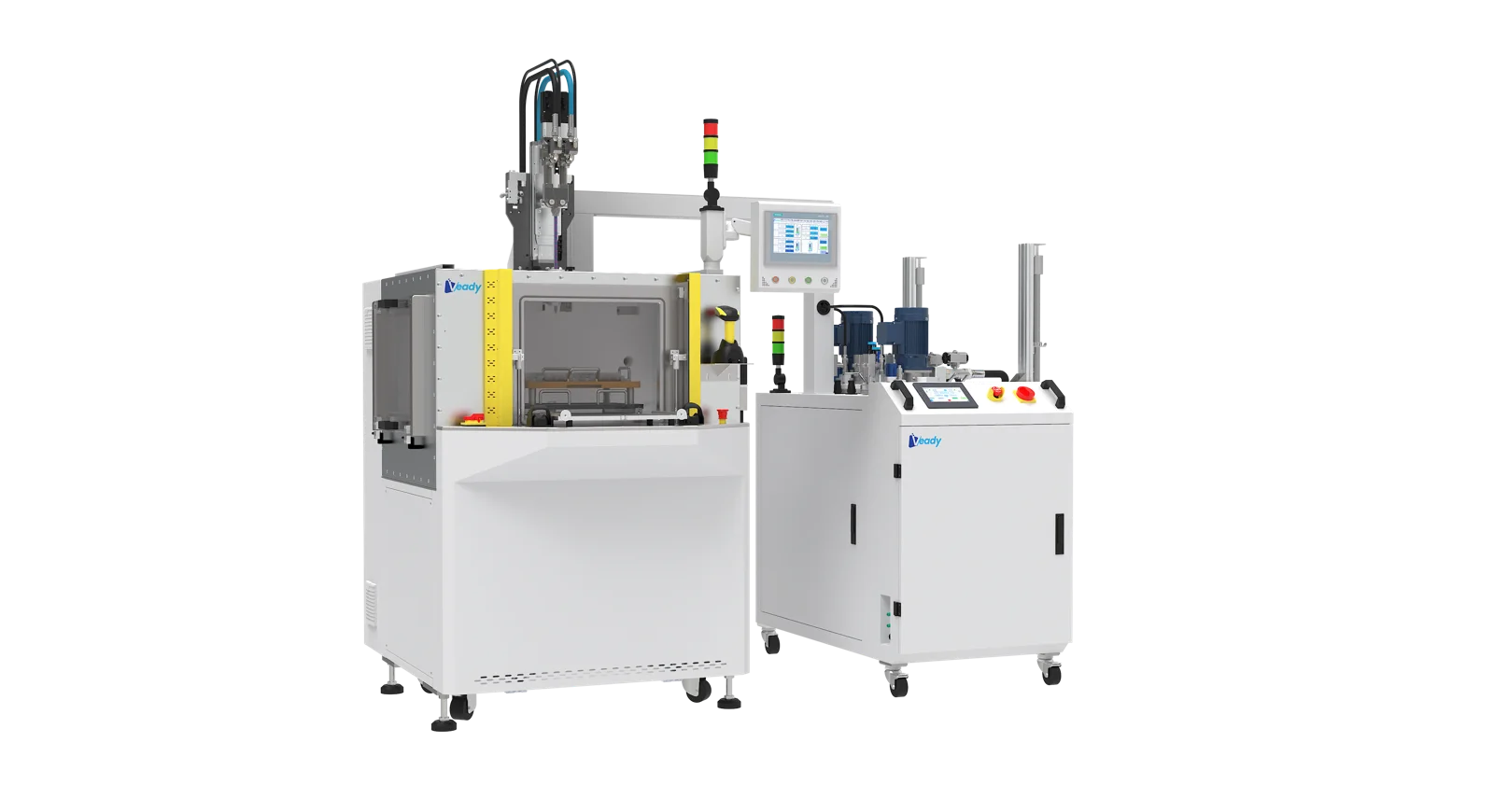
Choose between vacuum potting and atmospheric potting by asking where air can remain in the assembly and how the finished part will be accepted. A cavity that fills with a clear escape path for air may suit an atmospheric process. Tight gaps, windings or covered regions that retain air make a vacuum process worth evaluating. In either case, the equipment specification needs to follow the part, resin and inspection requirement.
This comparison is for electronic assemblies filled with potting compounds. It helps a process or purchasing team define a trial before selecting equipment.
Start with the void requirement and the part geometry
Write down what an acceptable potted part looks like before comparing machines. Which regions must be filled? Where would a void affect insulation, heat transfer or sealing? How will those regions be inspected? A visual check of the top surface cannot answer every question about the interior.
The geometry should then be reviewed against the proposed fill path. Resin entering a housing must give displaced air somewhere to go. Overhangs, narrow passages and winding spaces deserve particular attention. Atlas Copco's potting process overview distinguishes atmospheric and vacuum processing using component geometry and reliability requirements. Use those factors to form a trial plan rather than treating an industry name as a machine specification.
| Question about the assembly | Atmospheric route to evaluate | When to evaluate vacuum |
|---|---|---|
| Can air leave as resin enters? | An accessible cavity with a fill path that allows air to escape. | Covered regions, tight passages or windings retain air during filling. |
| What voids are acceptable? | The tested result meets the defined limits in the specified regions. | The atmospheric trial leaves unacceptable voids in critical regions. |
| How will quality be checked? | The agreed inspection confirms fill and cure for the actual part. | The same inspection is used to compare whether vacuum improves the result. |
| Can the production sequence fit? | Loading, filling and subsequent handling fit the required output. | Evacuation, dispensing, holding and pressure recovery fit a validated cycle. |
These are comparison questions, not universal acceptance limits. The product design and quality teams need to define allowable void size, location and inspection method. There is no single vacuum setting or cavity depth that selects the process for every resin and assembly.
Resin degassing and vacuum potting solve different air problems
Material preparation happens before the resin reaches the part. Degassing a feed tank addresses gas carried by the material. Filling a part introduces another problem: air already inside its geometry must be displaced while resin enters. A prepared resin can still leave a void beneath a feature that blocks the escape path.
Ask a supplier to describe the complete sequence: preparation, metering, mixing, filling and cure. Identify which stages operate under reduced pressure and where the material returns to atmospheric conditions. A description such as “vacuum system” is incomplete unless it identifies what is being evacuated.
Veady's article on heated resin tanks, stirring and degassing explains the preparation stage. That stage belongs in both process reviews. Whether the part also needs filling under vacuum remains a separate decision.
Compare the production cycle, not only the dispensing rate
A quoted dispensing rate describes one part of the cycle. For a useful comparison, time the sequence from a loaded fixture ready to process to a fixture ready for the next operation. Record the number of parts processed together and any operator work that overlaps the machine cycle.
For a vacuum route, include evacuation, any prescribed hold, filling, pressure recovery and unloading. For an atmospheric route, include preparation at the station, filling, any required settling or handling, and unloading. Account for changeovers and failed parts separately so that a short demonstration does not hide the work needed across a shift.
| Record | Unit or description | Comparison rule |
|---|---|---|
| Fill quantity | g per part or mL per part | Use the same approved fill requirement; record density if converting units. |
| Fixture capacity | Parts per cycle | Record the actual fixture and clearances. |
| Cycle stages | Seconds for each stage | Separate machine time, operator time and overlapping work. |
| Accepted output | Accepted parts in the observed run | Apply the same inspection and cure conditions. |
| Changeover and waste | Minutes and grams per changeover | Include fixture changes, purge material and restart checks. |
This record lets purchasing compare the proposed process with the factory's required output. It also gives engineering a way to explain why a nominal g/s figure does not establish parts per hour.
Use APS-641 and VPS-431 specifications as reference points
Veady publishes an atmospheric potting platform, APS-641, and an off-line vacuum potting platform, VPS-431. They provide concrete starting points for a configuration discussion. Their published work envelopes and utilities differ, so the comparison should include the fixture and installation requirements.
| Published field | APS-641 | VPS-431 |
|---|---|---|
| Equipment | Offline Automatic Potting Machine | Off-line Vacuum Potting Machine |
| Effective stroke | X600 × Y400 × Z100 mm | X400 × Y300 × Z100 mm |
| Dispensing speed | 1–5 g/s | 1–5 g/s |
| Vacuum Pressure field | No chamber-pressure value in this reference | 2 mbar |
| Power rating | AC220V, 50Hz, 7.5 kW | AC380V, 50Hz, 12.5 kW |
Source: the APS-641 technical reference and VPS-431 technical reference. These describe published configurations. Confirm the selected material, options and final performance requirements with Veady. Rated power is an installation field; it does not state measured energy consumption per part.
The VPS-431 reference lists 2 mbar without a complete test procedure for that field. Ask where pressure is measured, whether the reading is absolute or gauge pressure, and what conditions apply. The number alone cannot establish the pressure at every internal region of the workpiece or guarantee a void-free cured part.
Review the APS-641 atmospheric potting machine and the VPS-431 off-line vacuum potting machine alongside the actual part drawing. Keep work envelope, chamber access and fixture space as separate checks.
Run a comparison trial before selecting the process
Use the same part revision and identified resin system for both routes. Agree the acceptance method before running the trial. Record changes in temperature, fill path or timing; otherwise a better result cannot be attributed confidently to the pressure environment.
- Identify the resin and hardener, batch, technical data sheet revision, required A/B ratio and whether that ratio is by mass or volume.
- Record material temperature, preparation steps, dispensing quantity and the part's starting condition.
- Save the fill path and cycle sequence. For vacuum trials, record the pressure measurement basis, sensor location and time trace.
- Cure the samples under the specified conditions, then inspect the agreed regions using the agreed method.
- Repeat the production conditions that matter, including the planned fixture load and restart after a normal pause. Set the sampling plan with the responsible quality team.
Keep photographs or inspection records with the run ID. If both routes pass, compare production fit, maintenance and cost using the recorded cycle. If only one passes, retain the evidence and the conditions that made it pass. If neither passes, review the material preparation and fill strategy before assuming a larger machine will solve the defect.
What to include in a potting equipment RFQ
A useful request identifies the part drawing, resin TDS, ratio basis, fill quantity, critical regions, inspection requirement and production target. Include fixture dimensions and the utilities available at the installation site. If a pressure level has already been specified, explain its measurement basis and how it relates to the acceptance requirement.
Discuss your potting process with Veady using the requirements field on the contact page. Send drawings or reference files to veady@szweidi.com. The next step is a configuration review based on your material and part requirements.