
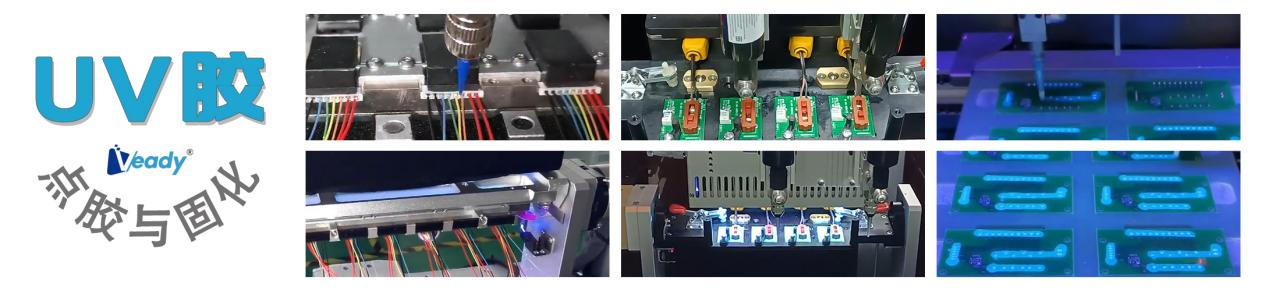
- Electronic Encapsulation: Such as PCB boards, chip encapsulation, and sensor dispensing, ensuring high bonding strength and stability.
- Optical Lens Assembly: Used for camera modules and microscope lens bonding, preventing adhesive overflow that could affect optical performance.
- Medical Device Manufacturing: Such as microfluidic chips and medical catheter bonding, meeting sterile and high-precision production requirements.
- Automotive Electronics: Applied in ADAS systems and automotive lamp encapsulation, enhancing shock resistance and sealing performance.
UV dispensing technology is gradually replacing traditional thermal curing or two-component adhesive processes, becoming the preferred solution for high-end manufacturing.
The core advantage of UV dispensing machines lies in their ultraviolet (UV) curing technology. The working principle is as follows:
(1)Dispensing Phase: A precision dispensing valve controls the adhesive volume, ensuring accurate application to specified locations.
(2)UV Curing Phase: A UV LED light source (typically with a wavelength of 365 nm–405 nm) irradiates the adhesive, triggering a photochemical reaction in the photoinitiators to achieve curing within seconds.
(3)Intelligent Control: Some high-end models are equipped with vision positioning systems and AI-based path planning to ensure precise dispensing trajectories.
Compared to traditional curing methods, UV dispensing machines offer advantages such as solvent-free volatilization, absence of thermal stress effects, rapid curing speed, and precise control. They are particularly suitable for miniaturized and high-precision manufacturing scenarios.
When selecting a UV dispensing machine, enterprises need to comprehensively consider the following factors:
(1)Dispensing Accuracy: High-precision industries (e.g., semiconductors) require micro-liter-level (0.01ml) dispensing valves.
(2)Curing Light Source: UV LED light sources offer long lifespans and low energy consumption, making them suitable for prolonged continuous operation.
(3)Adhesive Compatibility: The machine must accommodate UV adhesives of varying viscosities (e.g., low-viscosity adhesives are suitable for jet valves, while high-viscosity adhesives require screw valves).
(4)Automation Level: Equipment with CCD vision positioning and robotic arm integration can enhance production efficiency.
As a leading provider of dispensing equipment in the industry, Veady's UV dispensing machine series has gained significant market recognition for its high precision, exceptional stability, and intelligent features:
✅ Ultra-High Precision Dispensing: Utilizes imported piezoelectric ceramic valves, achieving a minimum dispensing volume of 0.01ml, ideal for microelectronics packaging.
✅ Intelligent UV Curing System: Customizable UV light source with adjustable curing time (0.1s-10s) to accommodate various adhesive requirements.
✅ Automated Integration Solutions: Supports robotic arm synchronization and vision positioning, enabling seamless integration with SMT production lines.
✅ Energy Efficiency & Environmental Sustainability: UV LED light source boasts a lifespan of over 20,000 hours, reducing energy consumption by 70% compared to traditional mercury lamps.
Veady dispensing machines have been successfully deployed across various sectors, including consumer electronics, automotive electronics, and medical devices, helping enterprises enhance production efficiency and product yield.
With the rise of emerging industries such as 5G communications, Mini LED, and AR/VR, UV dispensing machines are evolving toward higher precision and greater intelligence. Veady will continue to invest in R&D to drive advancements in dispensing technology, delivering more efficient solutions for global manufacturing.