
Off-line Vacuum Potting Machine
Shortlisting an automatic vacuum potting machine comes down to three questions: how much of the cycle should run without an operator, how deep the vacuum must g
Compare Vacuum Potting Machine Classes
Shortlisting an automatic vacuum potting machine comes down to three questions: how much of the cycle should run without an operator, how deep the vacuum must go, and how two-component material is fed, heated and degassed. This guide classifies off-line, in-line and modular potting equipment along those three axes, then compares the numbers that decide the purchase — 2 mbar vacuum pressure, ±3% proportion and dispensing precision, 1–5 g/s dispensing speed and a 100–300 m³/h vacuum system — so you can match a machine class to your production profile before you shortlist a vacuum potting machine manufacturer.
See the VPS-431 Off-line Machine Contact Us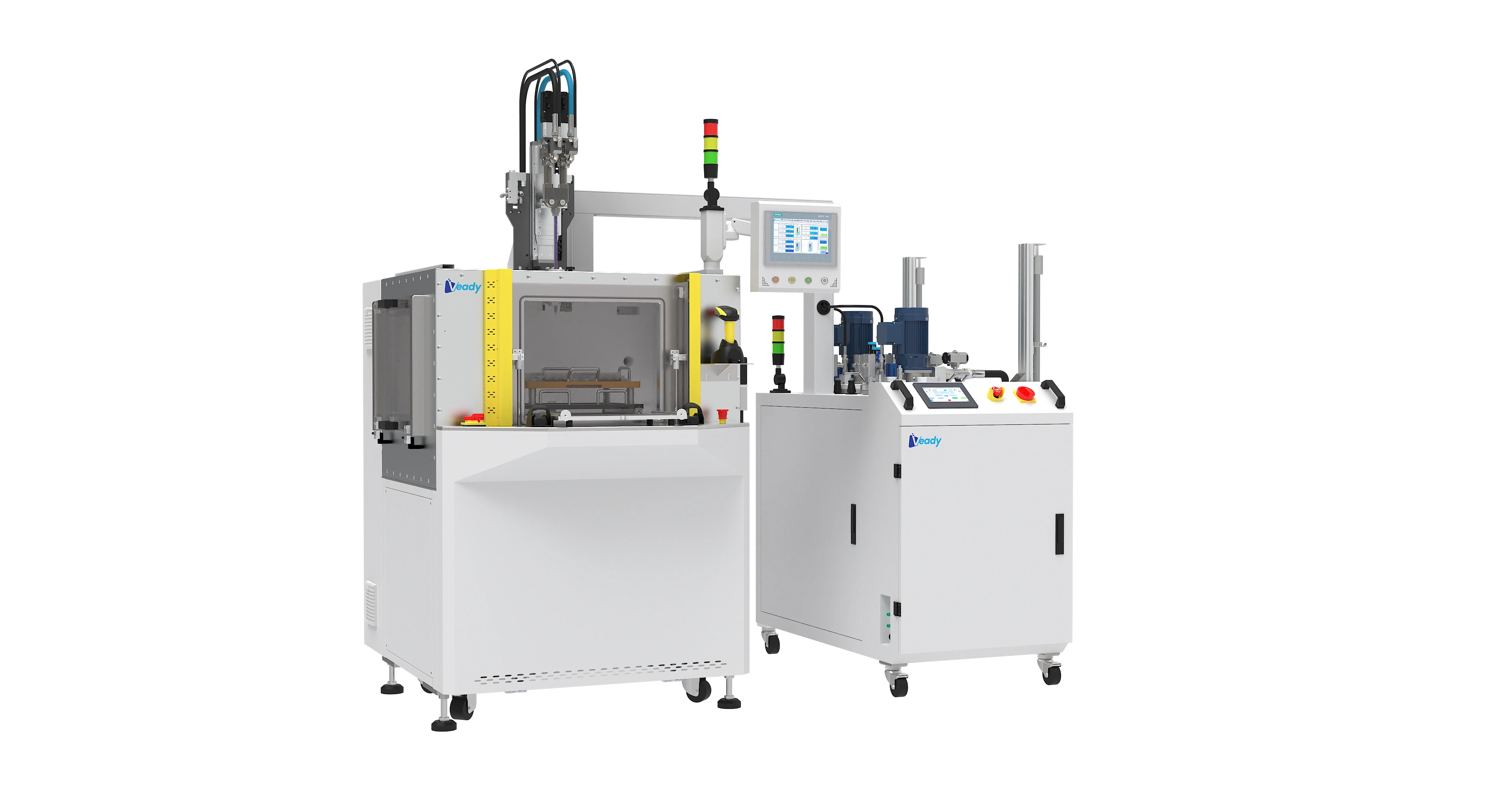
Selection axes
Automation × Vacuum × Material Handling
Every potting machine on the market is a combination of three independent choices. Fix these three and the machine class usually chooses itself.
1Automation level
- Manual / semi-automatic operation
- Off-line automatic unit
- Integrated in-line potting line
Buyer decision: automation buys cycle consistency and headcount reduction, not necessarily higher vacuum. Choose the lowest automation level that still holds your tolerance on the worst part in the mix.
2Vacuum architecture
- Single-stage vs. dual-stage pumping
- Chamber vacuum vs. external vacuum
- Vacuum system rated 100–300 m³/h
Buyer decision: vacuum architecture should follow cavity geometry and material viscosity. Deep, narrow cavities and high-viscosity filled resins need deeper vacuum and higher pumping capacity than open housings.
3Material handling
- A/B tanks with heating and stirring
- Cartridge-fed metering
- Pressure-plate feeding
Buyer decision: if your resin needs heating, defoaming, circulation or reflow before it reaches the mix head, specify a tank-based material preparation system rather than a simple feed.
Head-to-head
Comparison matrix: decision specs by machine class
Rows are the specifications that change a quotation. The off-line automatic column is populated with published VPS-431 data; remaining columns are class-level reference values that depend on the final configuration and should be confirmed with the Veady team before you compare a quotation.
| Decision spec | Off-line manual / semi-auto | Off-line automatic (VPS-431) | Integrated / in-line line | Standalone modules |
|---|---|---|---|---|
| Vacuum pressure | Confirm with Veady team | 2 mbar (dual-stage) | Confirm with Veady team | Not applicable — no chamber |
| Vacuum system rating | Confirm with Veady team | 100–300 m³/h | Confirm with Veady team | Not applicable — no chamber |
| Proportion precision | Confirm with Veady team | ≤±3% | Confirm with Veady team | Confirm with Veady team |
| Dispensing precision | Confirm with Veady team | ≤±3% | Confirm with Veady team | Confirm with Veady team |
| Dispensing speed | Confirm with Veady team | 1–5 g/s | Confirm with Veady team | Confirm with Veady team |
| Material preparation capacity | Confirm with Veady team | MFS4020, A: 40 L / B: 20 L | Confirm with Veady team | Set by host machine |
| Effective stroke | Confirm with Veady team | X 400 × Y 300 × Z 100 mm | Confirm with Veady team | Not applicable |
| Power rating | Confirm with Veady team | AC380V, 50 Hz, 12.5 kW | Confirm with Veady team | Confirm with Veady team |
| Operating air supply | Confirm with Veady team | 0.5–0.7 MPa | Confirm with Veady team | Confirm with Veady team |
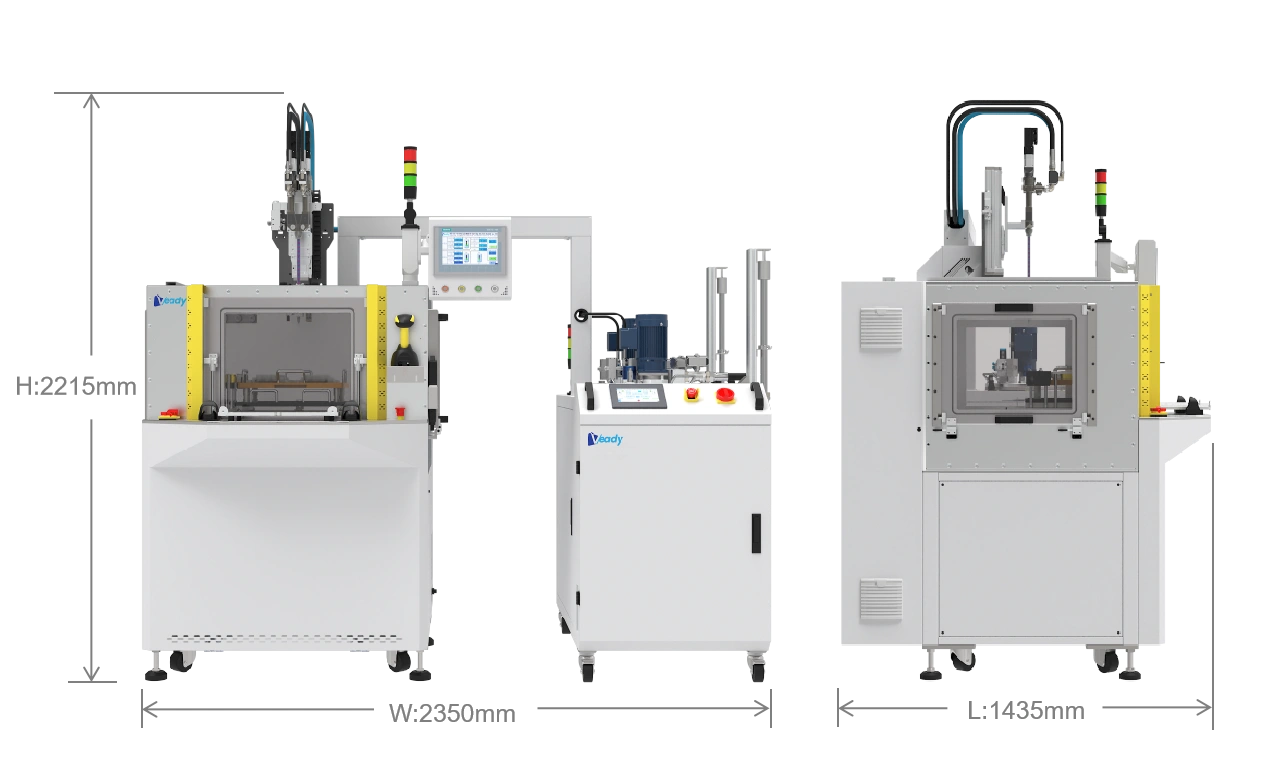
| Overall dimensions | Confirm with Veady team | L 1435 × W 2350 × H 2215 mm | Confirm with Veady team | Confirm with Veady team |
| Machine weight | Confirm with Veady team | Approx. 450 kg + 220 kg | Confirm with Veady team | Confirm with Veady team |
| Labour per shift | Operator-paced, confirm headcount for your takt | One operator for manual offline loading and unloading | Confirm with Veady team | No dedicated operator required |
| Changeover time | Confirm with Veady team | Depends on programme and fixture change — confirm for your part family | Confirm with Veady team | Confirm with Veady team |
| Material compatibility | Confirm with Veady team | Epoxy resin, polyurethane, silicone gel, thermally conductive silicone, organic potting adhesive and other two-component materials | Confirm with Veady team | Confirm with Veady team |
Spec decoder
What the numbers actually change downstream
A specification only matters if you can translate it into a part outcome. These four readings use the published VPS-431 values as the worked example.
2 mbar vs. 10 mbar: bubble formation
Vacuum level sets how much dissolved and trapped gas can escape before the resin gels. A dual-stage system reaching 2 mbar creates a fuller vacuum environment than a shallow single-stage pull, which is what makes bubble-free potting realistic on densely wound coils, stators and sensor bodies. Where a part has open housings and generous clearances, a shallower vacuum may be sufficient — the deep vacuum earns its cost on tight geometries and high-viscosity filled resins.
±3% precision: grams per part
Proportion precision and dispensing precision are both quoted at ≤±3% on the VPS-431. On a 200 g shot that is roughly ±6 g of total dispensed weight, split across the A and B components by the ratio being run. The practical consequence is shot-to-shot weight scatter across a batch, which drives whether you can release parts on weight check or must inspect each one. Tightening precision is a metering and control decision, not a chamber decision.
1–5 g/s: cycle time per part
Dispensing speed converts directly into cycle time. A 100 g shot at the low end of the range takes about 100 seconds of dispensing alone; at the high end, about 20 seconds. That difference is why dispensing speed, not vacuum level, often decides whether one offline machine can serve a shift or whether you need parallel units. Faster is only usable if the material still fills the cavity cleanly at that rate.
100–300 m³/h: scaling with chamber volume
Vacuum system rating is a pumping-capacity range, and it must be sized against chamber volume plus part and fixture displacement. A larger chamber, more parts per cycle or a gassier material all raise the demand on the pump. When you compare quotations, check that the quoted pumping capacity matches the chamber you are actually buying, not the smallest chamber in the range.
Scenario to specification
Match the machine class to your production profile
Read your own production profile first, then confirm the corresponding specification on the machine page. Each profile below states the labour, floor space and utility consequences you are signing up for.
High-mix / low-volume
Many part numbers, short runs, frequent programme changes. Prioritise changeover, not throughput.
Class Off-line manual or off-line automatic Labour One operator per unit per shift Space Standalone footprint, no line integration Utilities AC380V, 50 Hz, 12.5 kW; 0.5–0.7 MPa air Profile BMid-volume, multi-product
A stable core of part families with periodic new introductions. Balance repeatability against flexibility.
Class Off-line automatic with tank-based material preparation Labour Shared operator across stations where takt allows Space Split units plus material storage area Utilities Confirm heating and stirring loads for your resins Profile CHigh-volume, single product
One family, fixed takt, output measured per hour. Cycle time and uptime dominate every other criterion.
Class Integrated / in-line potting line Labour Line supervision rather than dedicated operator Space Full line layout including transfer and curing Utilities Confirm with Veady team for the configured lineMaterial handling
Which materials need conditioning, and which just need feeding
Material choice drives the third selection axis. If your compound separates, settles or gels cold, the material preparation system becomes the deciding module rather than the chamber.
| Material | Typical conditioning need | Why it matters for machine selection |
|---|---|---|
| Epoxy resin | Heating and stirring before metering; degassing under vacuum | Viscosity rises as temperature drops, so a heated, stirred A/B tank system keeps proportion precision stable through a shift. |
| Polyurethane | Moisture awareness and controlled stirring; avoid unnecessary dwell | Short pot life and moisture sensitivity make recirculation and reflow functions more valuable than extra tank volume. |
| Silicone gel | Gentle stirring; low-shear handling | Low-viscosity gels fill quickly, so dispensing speed settings and level monitoring matter more than vacuum depth. |
| Thermally conductive silicone | Continuous stirring to stop filler settling; defoaming | Filled compounds settle and trap gas, which is where defoaming plus dual-stage vacuum pays back on part yield. |
| Organic potting adhesive | Heating and level monitoring across colour and batch changes | Batch-to-batch variation shifts the mix ratio, so quantitative dispensing with a repeatable programme protects consistency. |
Get a machine class recommendation and a quotation
Send the part envelope, target cycle time, adhesive family and expected monthly volume. Veady quotes against the safest machine class for that profile and confirms every specification that varies by configuration.
- Factory-direct OEM services on configured equipment
- Split material preparation and potting units for staged buy-in
- Support for epoxy, polyurethane, silicone gel and two-component compounds
Related Products
Keep adjacent product options together for a faster catalog comparison.
Integrated Vacuum Potting Machine
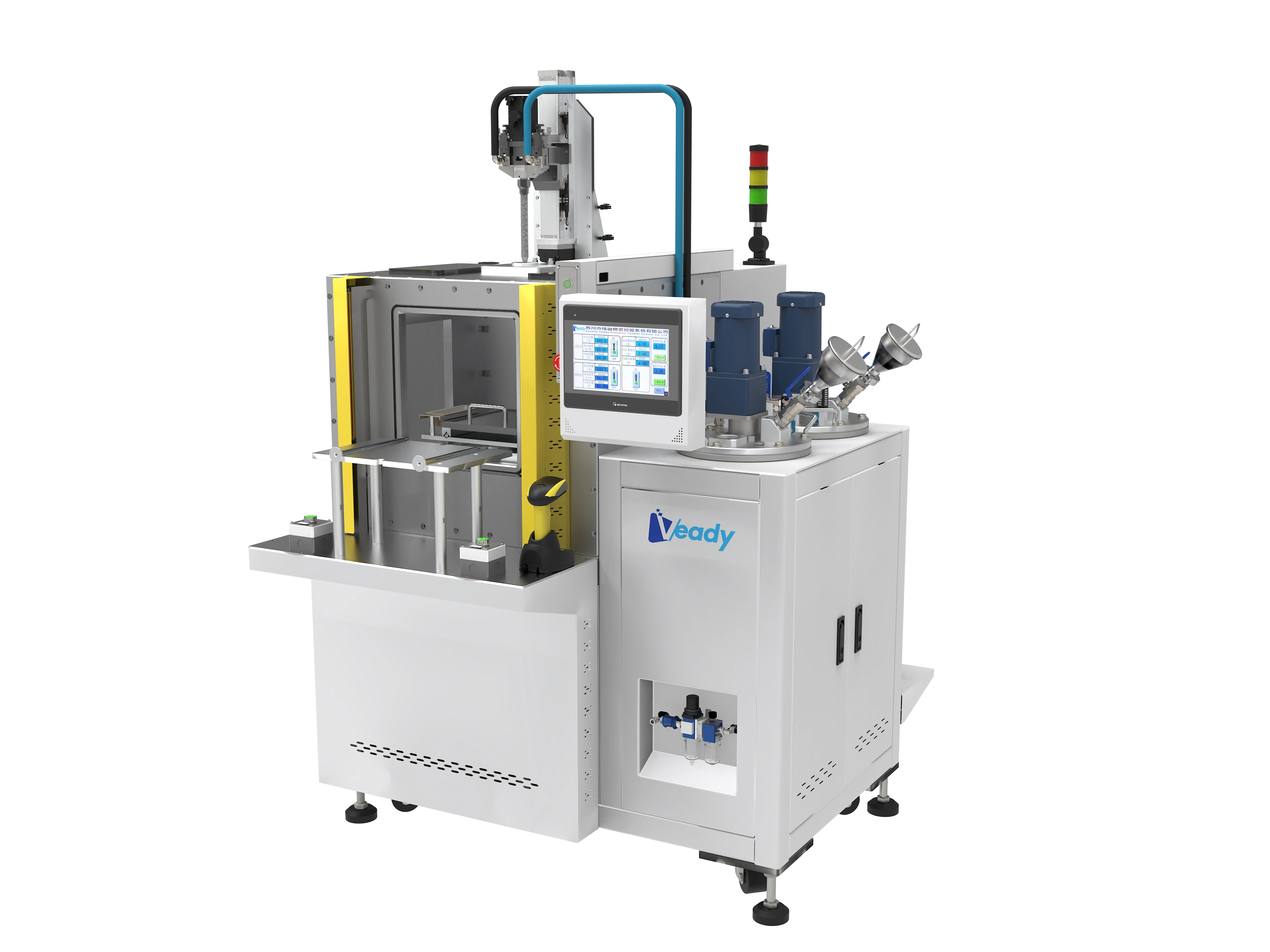
Stand-alone manual operation; integrated A/B material tanks and vacuum potting chamber with compact footprint; features professional precision metering and dynamic mixing technology, achieving vacuum…
View product →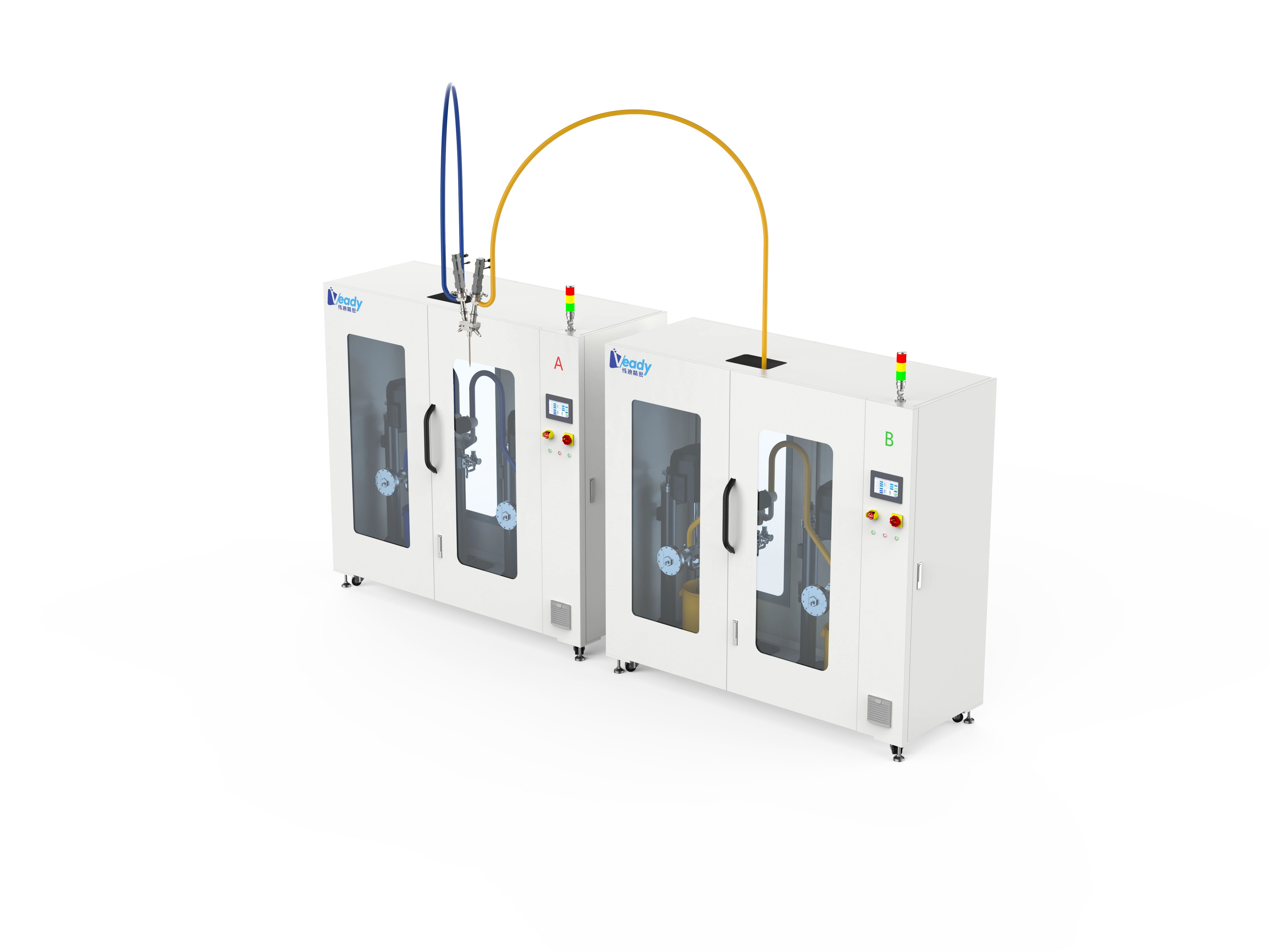
Redundant Feeding System
Equipped with four feed pumps to enable continuous operation during material changeovers. Ideal for automated dispensing stations in production lines.
View product →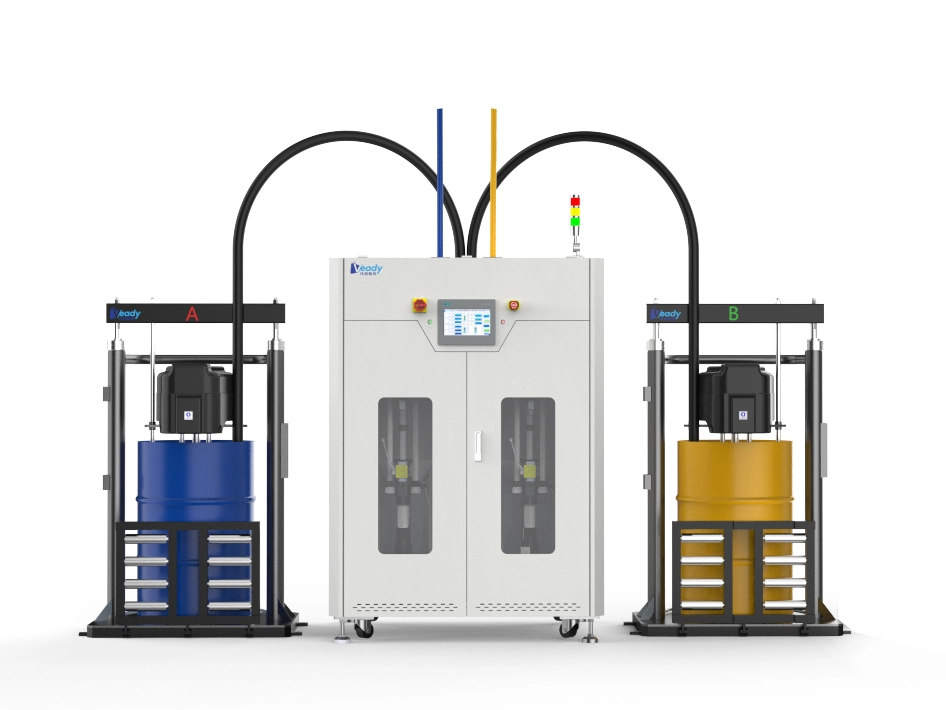
Dispensing Transfer System
Performs preconditioning including heating, vacuum degassing, stirring, and dehumidification of raw adhesive materials. Enables continuous feeding for two-component adhesives.
View product →Related Reading
Three notes to help clarify product requirements before contacting the supplier.
Related GuideHow to Choose an Off-line Vacuum Potting Machine for Small Batch Production
Choosing an off-line vacuum potting machine for small batch production comes down to matching travel, manual loading time, and resin chemistry to the parts you actually run.
Read article → Related GuideChoosing a Vacuum Potting Machine Manufacturer for Custom Equipment
A Tier 1 or Tier 2 plant sourcing a vacuum potting machine for custom production equipment needs to judge the supplier’s engineering depth, service network, and ability to adapt the build before…
Read article → Related GuidePlanning Custom Vacuum Potting Systems for IGBT and Motor Stator Production
An IGBT or motor stator program rarely matches a standard vacuum potting machine on the first pass, because workpiece geometry, resin volume, filler content, thermal window, and target cycle time all…
Read article →Frequently Asked Questions
what does “off-line” mean on the vps-431?
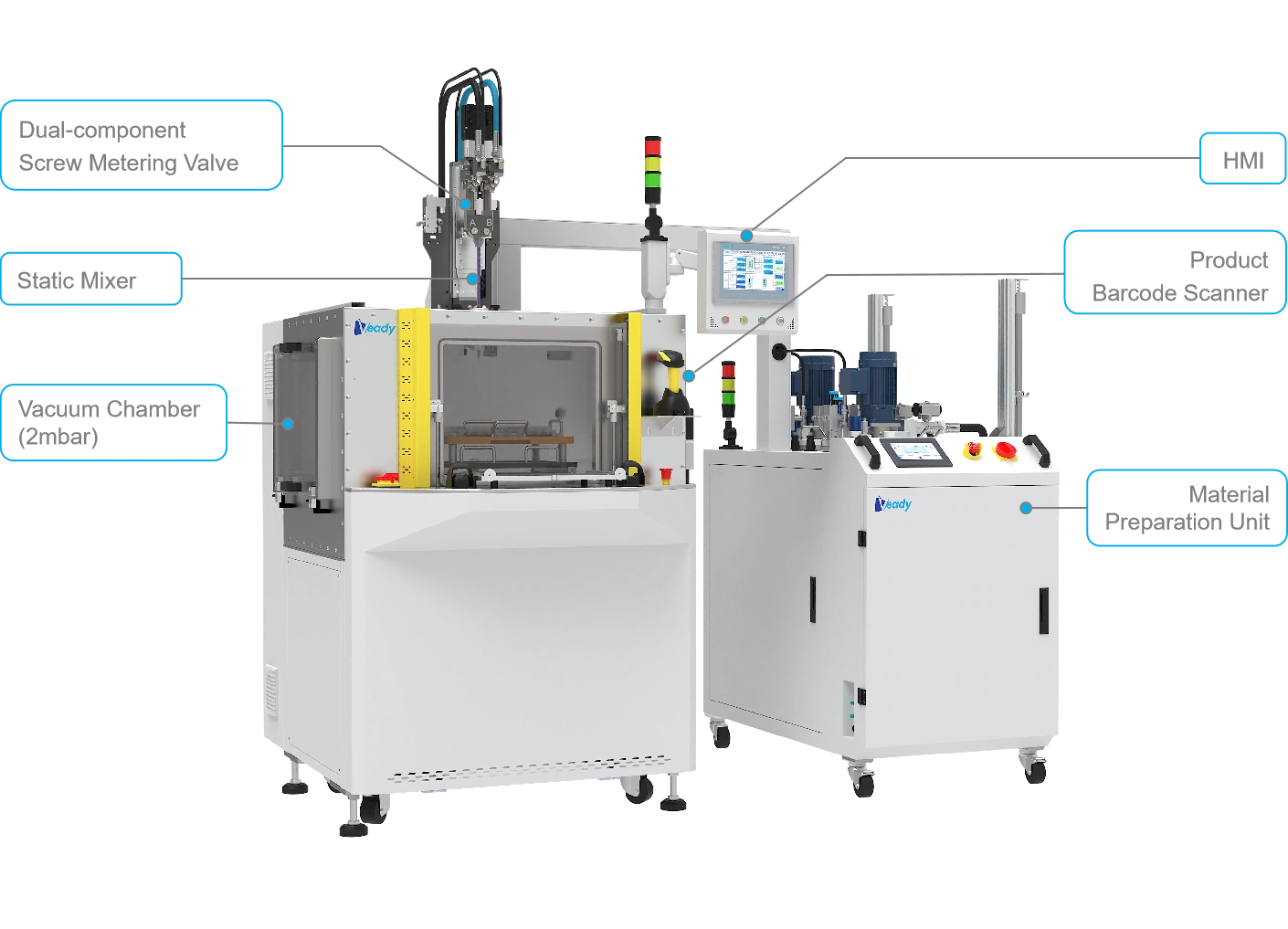
it is a standalone machine running offline manual operation rather than sitting inside a production line. the design is split into two units — a vacuum material preparation unit and a vacuum potting unit — and mixing, proportioning and quantitative dispensing of two-component adhesives are performed automatically once the cycle is started.
what vacuum level does the vps-431 reach?
the machine uses a dual-stage vacuum system with a maximum vacuum level of 2 mbar. that full vacuum environment is what makes bubble-free potting achievable on parts such as coils, stators, sensors and power modules.
how precise are the proportion and dispensing?
both proportion precision and dispensing precision are published as ≤±3%. precision comes from the three-axis motion system combined with proprietary control software that handles on-demand proportioning, mixing and quantitative dispensing.
what material preparation capacity is included?
the material preparation system is the mfs4020, with an a tank of 40 l and a b tank of 20 l. the a/b tanks include heating, stirring, liquid level monitoring, defoaming, circulation and reflow functions.
which adhesives and applications is it built for?
suitable materials include epoxy resin, polyurethane, silicone gel, thermally conductive silicone, organic potting adhesive and other two-component proportioning and mixing materials. stated applications cover automotive electronics, igbt modules, capacitors, new energy motors, high-voltage coils, ignition coils, electromagnetic coils, motor stators and sensors.
what utilities and floor space should i plan for?
plan for ac380v, 50 hz at 12.5 kw and a 0.5–0.7 mpa operating air supply. overall dimensions are l 1435 × w 2350 × h 2215 mm, with a machine weight of approximately 450 kg plus 220 kg. verify final layout and connection points with the veady team before installation.