
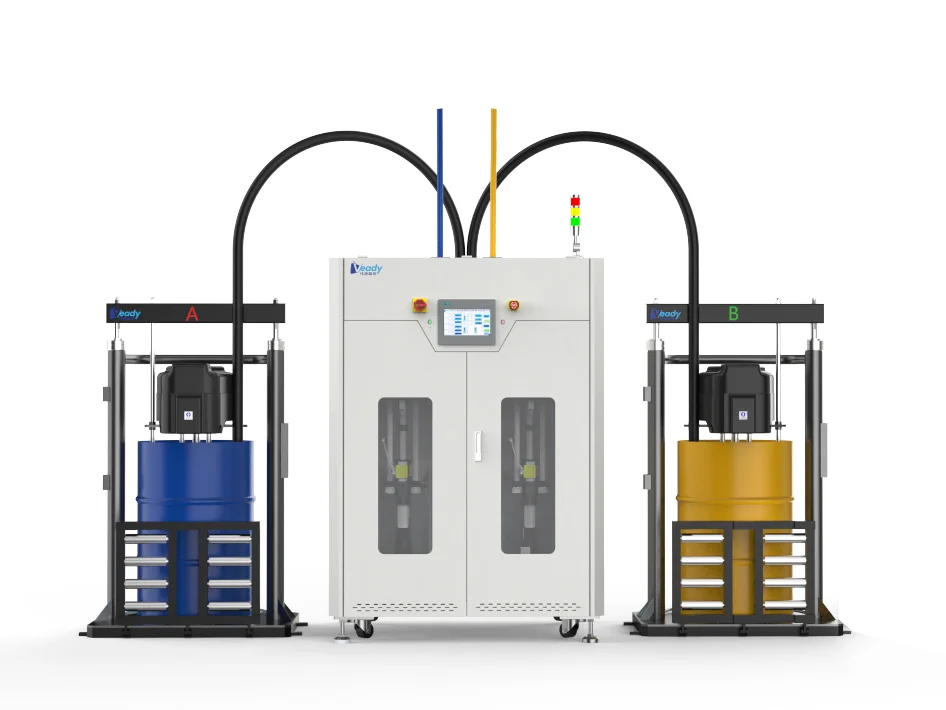
Move over the image to inspect details, or click to enlargeTap the image to inspect details
Dispensing Transfer System
- Model
- NEV4545
Performs preconditioning including heating, vacuum degassing, stirring, and dehumidification of raw adhesive materials. Enables continuous feeding for two-component adhesives.
Explore this part of the adhesive process
Product Features:
Integrates vacuum degassing, heated stirring, and liquid level monitoring.Utilizes modular design with high-precision metering valves to ensure stable dispensing processes and full production data traceability.
Specifications:
Suitable Adhesives:Two-component thermal conductive adhesives, sealants, structural adhesives, and other dual-cartridge materials.
Product Applications:Power batteries, energy storage batteries, PACK enclosures, battery modules, solar photovoltaics, etc.Preconditioning Functions
- Vacuum degassing — entrained air is drawn out of both components before they are metered, so the valve dispenses a repeatable volume instead of gas that later becomes a void in the bead.
- Heated stirring — continuous agitation keeps filled thermal materials from settling, while gentle warming brings each component to a flowable state before it travels down the line.
- Dehumidification — moisture is kept out of the material during long transfer runs, which matters for chemistries that skin over or thicken once they take on water.
- Liquid level monitoring — the controls track what remains in each station and warn the operator before a tank runs dry in the middle of a run.
- Prepared feed for an automated dispensing system — material reaches the valve in a steady state, so downstream equipment is not compensating for a cold or separated component.
- Process data traceability — the run is recorded, so the parameters behind a batch of parts can be reviewed if a quality question comes up later.
Adhesive Compatibility
Two-component thermal conductive adhesives, sealants, structural adhesives and other dual-cartridge materials all move through the same tanks and feed path. Filled thermal materials are the ones that gain most from continuous agitation, because conductive filler settles once a pail is left standing. Sealants and structural adhesives tend to be heavier and slower to move, so the heated, stirred condition is what keeps the feed steady at the valve. As adhesive dispensing equipment manufacturers, we match the transfer stage to the material rather than the other way round — tank, hose and feed settings are chosen around filler content, mix ratio and how quickly the chemistry cures.
Installation & Commissioning
- Bring the electrical supply and the compressed air line to the agreed position and test both before the unit is set down.
- Connect the services to the control cabinet and check that both drum stations sit where your material handling can reach them easily.
- Load part A and part B, then bring each tank up to your process temperature and let the stirrers work the material until it is uniform.
- Prime the feed path and draw material through to the metering valve, checking every joint for air pockets or leaks before production starts.
- Run a trial batch and record the settings — degassing behaviour, level alarm points and feed rate — so the same parameters can be repeated on the next shift.
Technical Support & Model Matching
As the manufacturer, Suzhou Veady Precision Glue Dispensing Systems Co., Ltd supports your project from selection through startup. Share your adhesive, substrate, throughput and accuracy target, and our engineers help match the right dispensing, potting, vacuum potting or material preparation configuration. We also guide installation and commissioning, process parameter setup, and fault troubleshooting, and provide factory-direct service and bulk supply for long-term production.
FAQ
Q1 How do the two components stay separate before they mix?
The unit has two independent stations, one for part A and one for part B, each with its own tank, pump and hose. The two materials only meet at the mix point downstream, normally the metering valve or a static mixer. Because nothing is shared before that point, neither component is contaminated by the other between runs.
Q2 How does an operator run the system during a shift?
One operator can manage it. The cabinet's touchscreen shows the condition of both stations, and the indicator light tower gives a status check from across the aisle, so the rest of the glue dispensing system keeps running while material is loaded. The A and B stations are labelled to make refilling and checking straightforward.
Q3 Can this unit feed the dispensing line we already have?
Yes. It is built to deliver prepared material to the valve on an existing automated dispensing system. Send us the valve model, the mix ratio you run and the length of the hose run, and we will confirm the feed arrangement and the connection point before the unit is built.
Q4 What cleaning does the unit need between production runs?
Wipe down the cabinet and the station surfaces, check the hoses for kinks or hardened material, and follow a flushing routine on the feed path whenever the adhesive is changed or the line stops for a long period. Chemistries that cure quickly deserve particular attention at the valve and hose joints.
Q5 What should we confirm about our adhesive before ordering?
Filler content, mix ratio, viscosity and cure speed all affect how a material behaves in the tank and the feed path. As adhesive dispensing equipment manufacturers, we check your datasheet against the equipment that will handle it — send the material details with your enquiry and we will confirm the configuration.
Q6 Does the unit have to be fixed in place?
It is built on a wheeled base, so it can be rolled into position and moved again if the line layout changes. Once it is where you want it, level it and secure it, and leave clearance at the cabinet doors and at both drum stations for loading and service.
Technical specifications
| Parameter | Specification |
|---|---|
| Equipment Name | Dispensing Transfer System |
| Model | NEV4545 |
| Transfer Tank | 45L × 2 |
| Vacuum Degassing | ≤1 mbar |
| Feed Pump | 55 Gallons |
| Agitation Speed | 10-60/rmp |
| Heating Temperature | Ambient temperature to 80 °C |
| Power Supply | AC220V, 50 Hz, 7.5 kW |
| Air Supply | 0.5-0.7 MPa |
| Dimensions | L=3000 × W=1200 × H=2000 mm |
| Weight | Approx. 750 kg |
Technical specifications for the listed model. For application engineering, share your adhesive datasheet, part drawing and production requirements.