
Move over the image to inspect details, or click to enlargeTap the image to inspect details
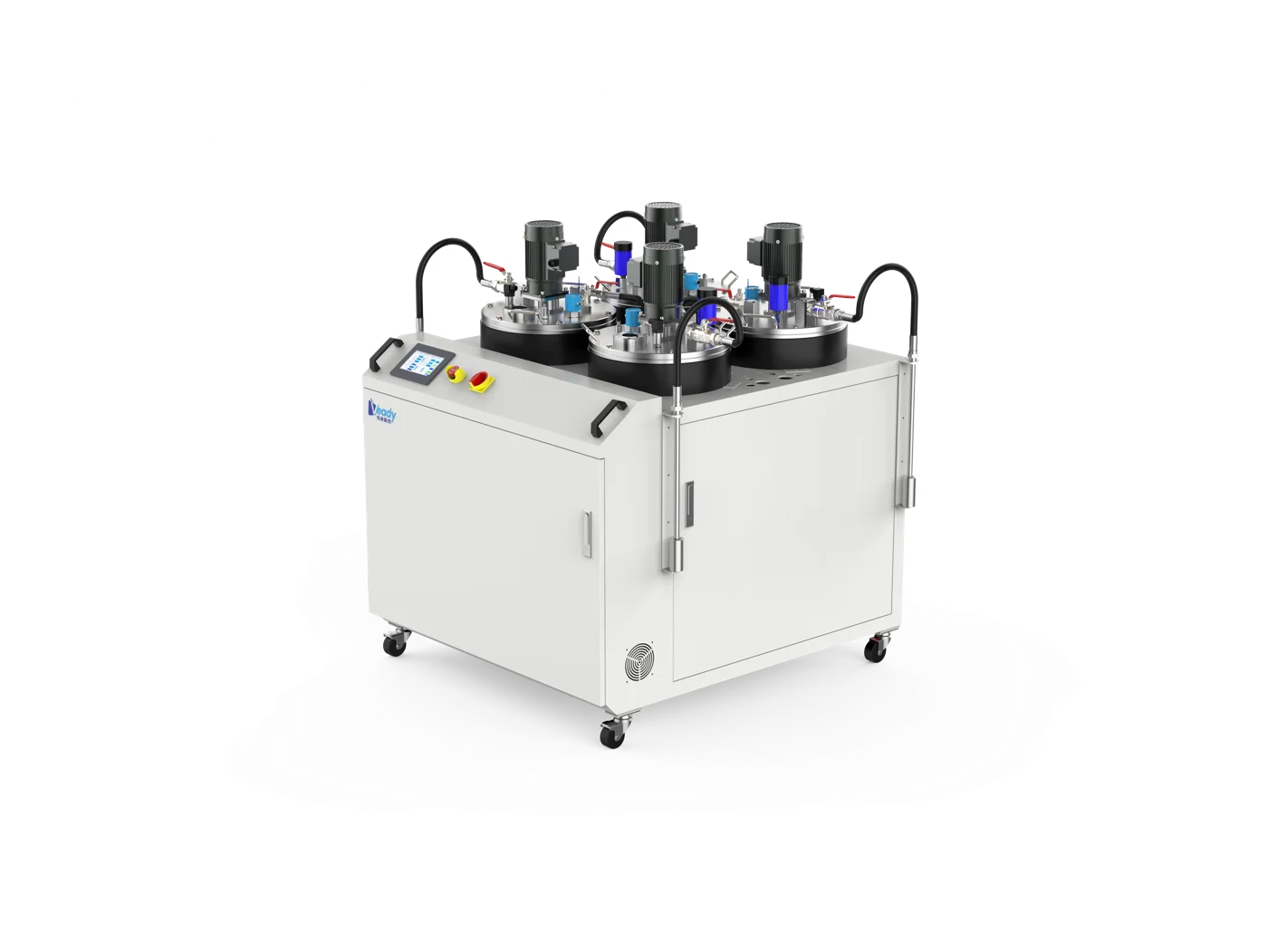
1-Standby-1-Operation Material Preparation Unit
- Model
- MFS4520-2
Four-tank design with one standby and one in operation enables non-stop feeding and continuous glue supply operations.
Explore this part of the adhesive process
Product Features:
It preprocesses the adhesive and can be compatible with various glue supply methods such as gear pumps, screw pumps, diaphragm pumps, and plunger pumps according to the adhesive characteristics, achieving precise two-component feeding and metered dispensing.
Specifications:
Suitable Adhesives:Epoxy resin, polyurethane, silicone resin and other two-component adhesives.
Product Applications:Servo motors, new energy motors, micro switches, OBC charging modules, automotive electronics, precision sensors, ignition coils, solar photovoltaics, etc.
Standby & Operation Tank Design
- Paired tanks — four tanks are grouped as two A/B pairs, each pair holding one larger A tank and one smaller B tank so a complete two-component set is always staged together.
- Individual agitation — every tank has its own top-mounted motor driving an agitator, so the material in a waiting pair is kept in motion rather than left standing.
- Standby switchover — one pair feeds the line while the other is prepared, which is how the changeover keeps an automated dispensing system supplied instead of leaving the pump to run dry.
- Controls and mobility — a touchscreen panel and an emergency stop sit on the front of the cabinet, and the whole unit runs on casters so it can be pulled clear for cleaning or service.
- Matched outlet — feed lines, pressure and control signals are set around the pump downstream, whether that pump is one of ours or comes from other glue dispensing machine manufacturers.
Adhesive Compatibility
The feed side of this unit is not tied to one pump family. Gear pumps, screw pumps, diaphragm pumps and plunger pumps can all be supplied from the tanks, and which one is right follows the material itself — its working viscosity, how much filler it carries, how it reacts to shear, and the mix ratio it needs. That is why we ask for your adhesive before recommending a configuration. The tank outlet, feed pressure and control settings are then set around the pump and valve downstream, so the preparation and metering stages behave as one chain rather than two pieces of equipment bolted together. As a dispensing machine manufacturer we also build the pump, valve and metering stages that sit after the tanks, which is how those settings stay consistent from the tank outlet through to the nozzle.
Technical Support & Model Matching
As the manufacturer, Suzhou Veady Precision Glue Dispensing Systems Co., Ltd supports your project from selection through startup. Share your adhesive, substrate, throughput and accuracy target, and our engineers help match the right dispensing, potting, vacuum potting or material preparation configuration. We also guide installation and commissioning, process parameter setup, and fault troubleshooting, and provide factory-direct service and bulk supply for long-term production.
FAQ
Q1 Where does this unit sit in an adhesive dispensing system?
It sits between the adhesive supply and the dispenser. The tanks hold and condition the two components, then feed them to the pump and valve that meter the dose. The unit's job is to make sure material arrives at the dispenser at the right temperature and in the right condition — the metering itself still happens downstream.
Q2 Can we change the feed pump type later?
Usually yes. The unit is compatible with gear, screw, diaphragm and plunger feed methods, so a material change, or a different glue dispensing system on the same line, can often be handled by re-specifying the feed side rather than replacing the tanks. Tell us the new material and we will confirm what has to change.
Q3 Can one unit supply more than one dispensing head?
It depends on your dose and cycle time. On an automated dispensing system with several heads, one unit can supply a shared pump and manifold set as long as the combined flow stays inside the feed range. Tell us how many heads you run and the dose each one takes, and we will confirm the layout.
Q4 Can the unit be matched to a pump or metering valve we already own?
That is how most units are specified. As a dispensing machine manufacturer we set the outlet, feed pressure and control signals around the pump and valve you already run, including equipment from other brands. Send the make, model and outlet size and we will confirm the match.
Q5 What routine maintenance does the unit need?
Keep the tank interiors, agitator shafts and pipe runs clean, and check the vacuum circuit and filters as part of your shift routine. Material left standing too long is the usual cause of hardened residue on two-component equipment, so a short cleaning cycle at the end of each batch is worth the time.
Q6 Will the unit handle filled or abrasive adhesives?
Filled and abrasive materials put the wear on the pump, valve and hoses rather than on the tanks, so the deciding factor is which feed method suits the filler. Tell us the filler type and content and we will confirm the feed side for your material.
Technical specifications
| Parameter | Specification |
|---|---|
| Equipment Name | 1-Standby-1-Operation Material Preparation Unit |
| Model Number | MFS4520-2 |
| Vacuum Negative Pressure | ≤2 mbar |
| Heating Temperature | Room temperature to 80 °C |
| Proportion Precision | ≤±3% |
| Dispensing Precision | ≤±3% |
| Dispensing Speed | 3-10 g/s |
| Tank Specification | (A: 45L + B: 20L) × 2 |
| Power Rating | AC220V, 50 Hz, 2.5 kW |
| Operating Air Supply | 0.5-0.7 MPa |
| Overall Dimensions | L=1350 × W=700 × H=1430 mm |
| Machine Weight | Approx. 200 kg |
Technical specifications for the listed model. For application engineering, share your adhesive datasheet, part drawing and production requirements.