
Move over the image to inspect details, or click to enlargeTap the image to inspect details
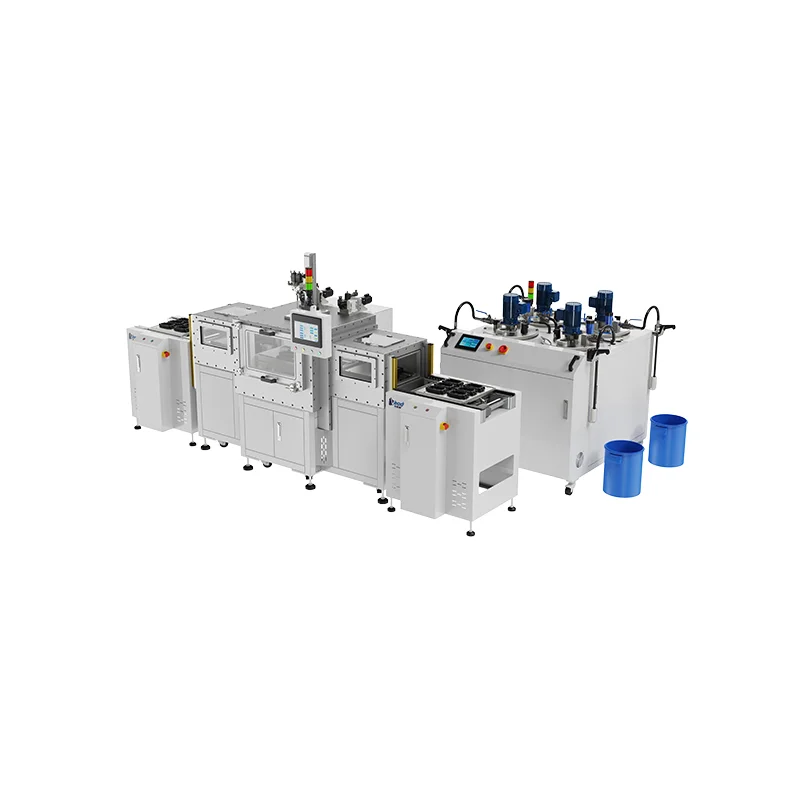
Three-Stage Vacuum Potting Machine
- Model
- VPS-641
Three-chamber vacuum chamber for continuous operation: products enter the pre-vacuum chamber, move to the vacuum chamber for potting, and are sent out under vacuum holding pressure after potting. With a maximum vacuum level of 2mbar, it enables efficient automated operations.
Explore this part of the adhesive process
Product Features:
The vacuum material preparation system and three-axis motion module support high-precision potting with multiple trajectories. Equipped with a dynamic mixing valve, it enables production data management and fully automatic assembly line operations.
Specifications:
Suitable Adhesives:Epoxy resin, polyurethane, silicone gel, thermally conductive silicone, organic potting adhesive, and other two-component proportioning and mixing materials.
Product Applications:Automotive electronics, IGBT modules, capacitors, new energy motors, high-voltage coils, ignition coils, electromagnetic coils, motor stators, sensors, etc.
Three-Stage Vacuum Process
- Pre-vacuum before filling: parts are de-aired while still dry, so air held in windings, connector gaps and component edges is removed before any resin arrives.
- Potting under vacuum: adhesive is dispensed while the chamber is still under vacuum, which lets the resin flow into narrow gaps instead of pushing a pocket of air ahead of it.
- Vacuum holding after potting: parts stay under vacuum for a holding period rather than being vented the moment filling ends, so the fill settles without bubbles rising into it.
- Three positions in one chamber system: pre-vacuum, potting and holding are arranged as a sequence, so each cycle follows on from the last instead of stopping while a single chamber vents and recharges.
- Aimed at void-sensitive parts: this vacuum potting equipment earns its extra stage where a bubble affects insulation or heat transfer rather than just appearance.
Motion, Metering & Process Control
Potting accuracy comes from three parts working together. A three-axis motion module carries the mixing valve across the working area and supports several potting trajectories, so one program can follow a rectangular housing, a circular stator or a row of small sensor pockets without re-fixturing the parts. The dynamic mixing valve combines A and B at the point of dispense, which keeps the mixed volume small and removes the pot-life clock that comes with pre-mixed adhesive. Because we build the valve and metering side ourselves as a dispensing machine manufacturer, ratio and dispense rate are matched to the material rather than the material being matched to the machine. Run data is logged from each cycle, so a batch can be traced back to the parameters that produced it.
Adhesives & Material Preparation
- A and B prepared separately: each component is de-aired in its own tank before the mixing valve sees it, which is where most air enters a filled adhesive system.
- Mixed at the point of dispense: the two components are fed independently and combined at the valve, so there is no pot-life clock running against a pre-mixed batch and no mixed material left over at the end of a run.
- Filled materials need a closer look: thermally conductive and other heavily filled adhesives move differently through feed lines and valves, so viscosity, filler content and pot life are checked before the configuration is confirmed.
- Degassing before, not after: air is taken out of the components ahead of potting rather than chased out of the cavity afterwards, which shortens the time each part spends under vacuum.
- Built by the people who make the mixing side: we are one of the adhesive dispensing equipment manufacturers that produces its own valves and metering units, so the mixing hardware is chosen for the adhesive you actually run.
Installation & Commissioning
- Plan the bay: check the layout drawing against the space before delivery, and have the power and air connections ready at the drop point.
- Position and level the potting unit and the material preparation unit, keeping the tank side clear for refilling and daily checks.
- Connect and pressure-test the A and B feed lines between the two units before any adhesive is loaded.
- Fill the tanks, run the preparation stage and check the mixing valve for leaks or trapped air.
- Commission the vacuum potting system on sample parts: run the three-stage sequence and adjust ratio and dispense rate until the fill is clean.
- Before the machine ships, confirm the part envelope, fixture or tray design, adhesive type and target output with our engineers, so the metering and valve side is matched to your product rather than set to a generic configuration.
Technical Support & Model Matching
As the manufacturer, Suzhou Veady Precision Glue Dispensing Systems Co., Ltd supports your project from selection through startup. Share your adhesive, substrate, throughput and accuracy target, and our engineers help match the right dispensing, potting, vacuum potting or material preparation configuration. We also guide installation and commissioning, process parameter setup, and fault troubleshooting, and provide factory-direct service and bulk supply for long-term production.
FAQ
Q1 What part sizes can this vacuum potting machine handle?
Parts sit in a fixture or tray inside the working area, and the mixing valve travels over them on the three-axis gantry. Anything that fits within the machine's X, Y and Z stroke and clears the valve path can be run. Send the drawing with the tallest component and the connector positions so the fixture and travel can be checked before the machine is assembled.
Q2 Can it run single-component adhesives as well as two-component materials?
This machine is built around two-component proportioning and mixing, so A and B are supplied and metered separately. Single-component adhesives are handled by a separate preparation unit in the range, and as one of the adhesive dispensing equipment manufacturers that builds both, we can point you to the right setup once we know which route your product takes.
Q3 Can the machine be added to an existing production line?
The vacuum potting equipment is built for automatic operation once a part is loaded on its fixture: pre-vacuum, potting and vacuum holding run as one sequence without an operator at the chamber. How parts are fed in and out, and what happens upstream and downstream, is worked out with your engineers, so share the line layout and cycle target early.
Q4 What maintenance does it need between shifts?
Keep the routine on the material path: purge the mixing valve and feed lines before a long stop or a shift handover, keep the A and B lines clean, and check the chamber seals so the vacuum potting system pulls down quickly each cycle. Leave the tank side accessible for refilling and a visual check between batches.
Q5 Does the machine include its own material preparation unit?
The potting chamber and the vacuum material preparation unit work as one setup, with A and B held in separate tanks and fed to the mixing valve. The preparation unit stands beside the potting unit as a second module, so allow floor space and service access on the tank side for refilling and daily checks.
Q6 What changes when we switch to a different product?
The part fixture or tray and the potting program change; the chamber, metering and mixing hardware stay as they are. Each product keeps its own stored ratio, dispense rate and vacuum setting, so going back to a previous job means loading the right fixture and recipe rather than re-tuning the machine from scratch.
Technical specifications
| Parameter | Specification |
|---|---|
| Equipment Name | Three-Stage Vacuum Potting Machine |
| Model Number | VPS-641 |
| Effective Stroke | X=600 × Y=400 × Z=100 mm |
| Vacuum Pressure | 2 mbar |
| Vacuum System | 100-300 m³/h |
| Proportion Precision | ≤±3% |
| Dispensing Precision | ≤±3% |
| Dispensing Speed | 3-10 g/s |
| Material Preparation System | MFS4545 (A: 45L / B: 45L) |
| Power Rating | AC380V, 50 Hz, 12.5 kW |
| Operating Air Supply | 0.5-0.7 MPa |
| Overall Dimensions | VPS-641: L=3560 × W=1025 × H=1750 mm MFS4545: L=700 × W=1350 × H=1500 mm |
| Machine Weight | Approx. 1150 kg + 280 kg |
Technical specifications for the listed model. For application engineering, share your adhesive datasheet, part drawing and production requirements.